
Wheel Nuts
Precision Internally-Threaded Wheel Nuts, Manufactured in Birmingham
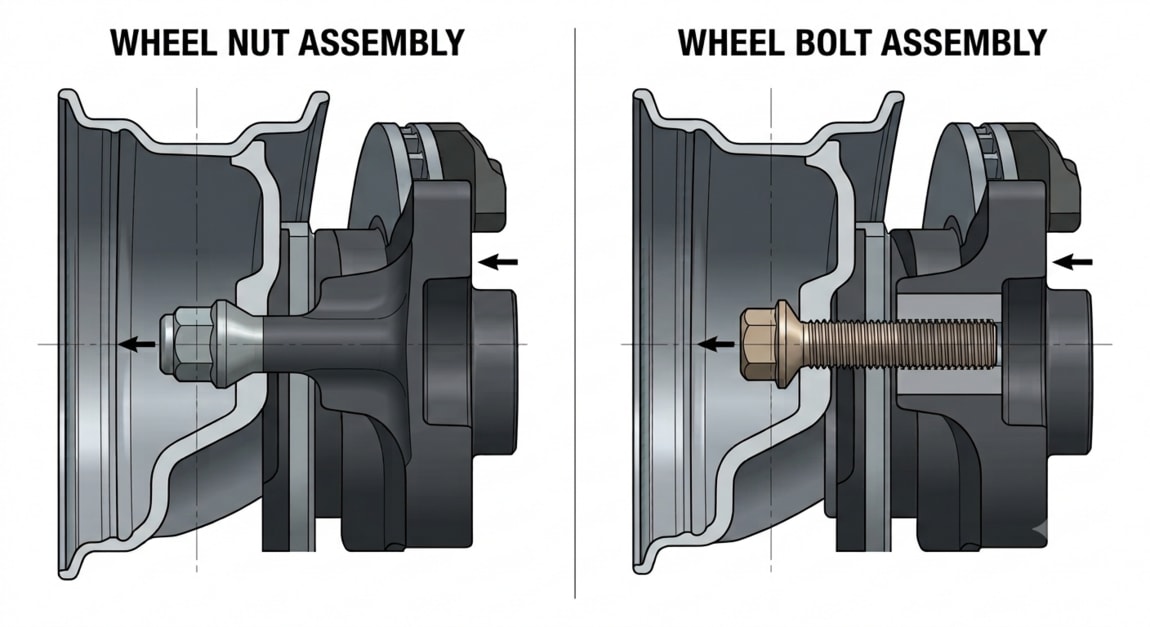
Trojan Special Fasteners manufactures wheel nuts, internally threaded fasteners that secure a wheel onto the projecting threaded studs of a wheel hub, across passenger car, commercial vehicle, trailer, and classic and vintage restoration applications. We do not manufacture wheel bolts, externally threaded fasteners that thread directly into a tapped hub. If your vehicle uses a bolt-on wheel fixing rather than a stud-and-nut arrangement, you need a wheel bolt, which falls outside our current manufacturing scope.
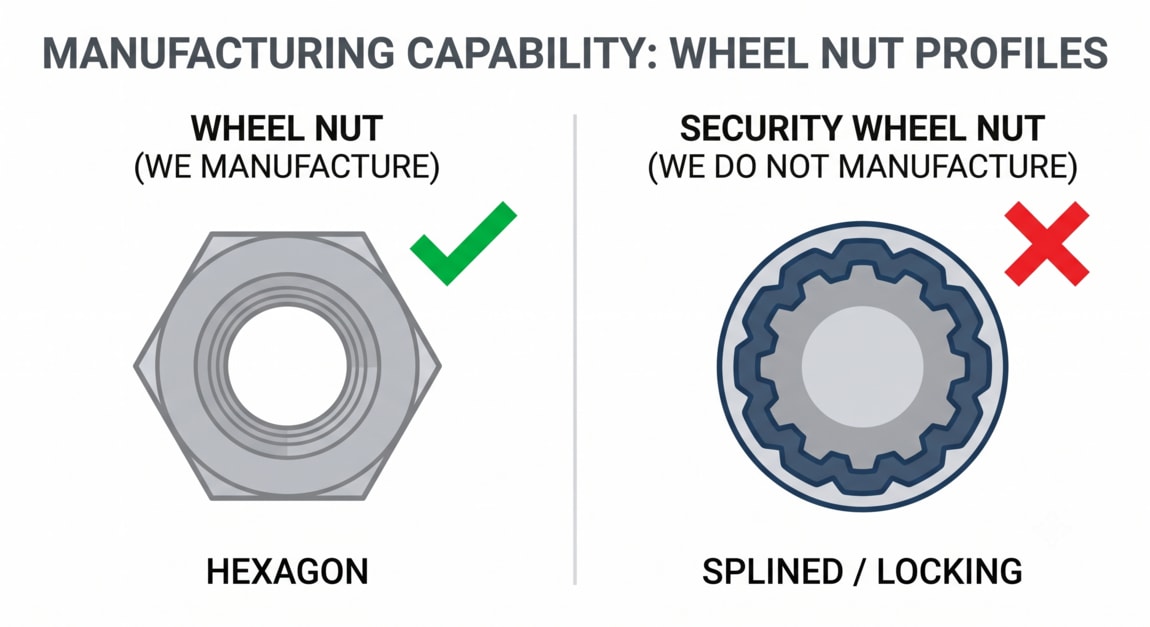
We manufacture wheel nuts in hexagon and square profiles only. We do not machine splined, broached, or multi-lobe security head forms.
International Terminology for Wheel Nuts
The fastener itself is functionally identical worldwide, but the name varies by region and market:
| TERM | REGION/MARKET |
|---|---|
| Wheel Nut | United Kingdom, Australia, most Commonwealth markets |
| Lug Nut | United States, Canada |
| Écrou de roue | France |
| Radmutter | Germany, Austria, Switzerland |
| Dado ruota | Italy |
| Tuerca de rueda | Spain, Latin America |
| Wielmoer | Netherlands |
| Hjulmutter | Sweden, Norway, Denmark |
| ホイールナット (hoiru natto) | Japan, transliterated from English |
| 轮毂螺母 (lúngǔ luómǔ) / 轮胎螺母 (lúntāi luómǔ) | China |
| Mur roda | Indonesia |
| Tuerca de rueda / Birlo (colloquial) | Mexico |
Seat Types We Manufacture
- Conical (taper) seat: The most common wheel nut seat, typically 60° included angle, with 45° also available. The taper self-centres the wheel on the stud pattern as the nut is tightened, reducing the risk of vibrational loosening.
- Radius (spherical/ball) seat: Used where the wheel or hub design requires a rounded bearing face rather than a taper, common on certain commercial vehicle and aftermarket alloy wheel fitments.
- Flanged seat: An integral flange increases bearing surface area against the wheel, spreading clamp load and reducing the risk of the nut pulling through softer alloy wheel material.
- Flat seat: Used with a separate washer, or where the wheel itself provides the correct seating geometry.

Wheel Nut with a Cone Seat

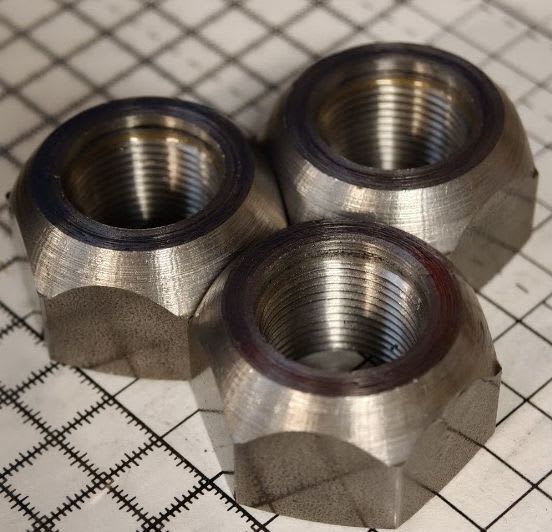
Hexagon Wheel nut with Radius Seat

Conical Hexagon Wheel Nut
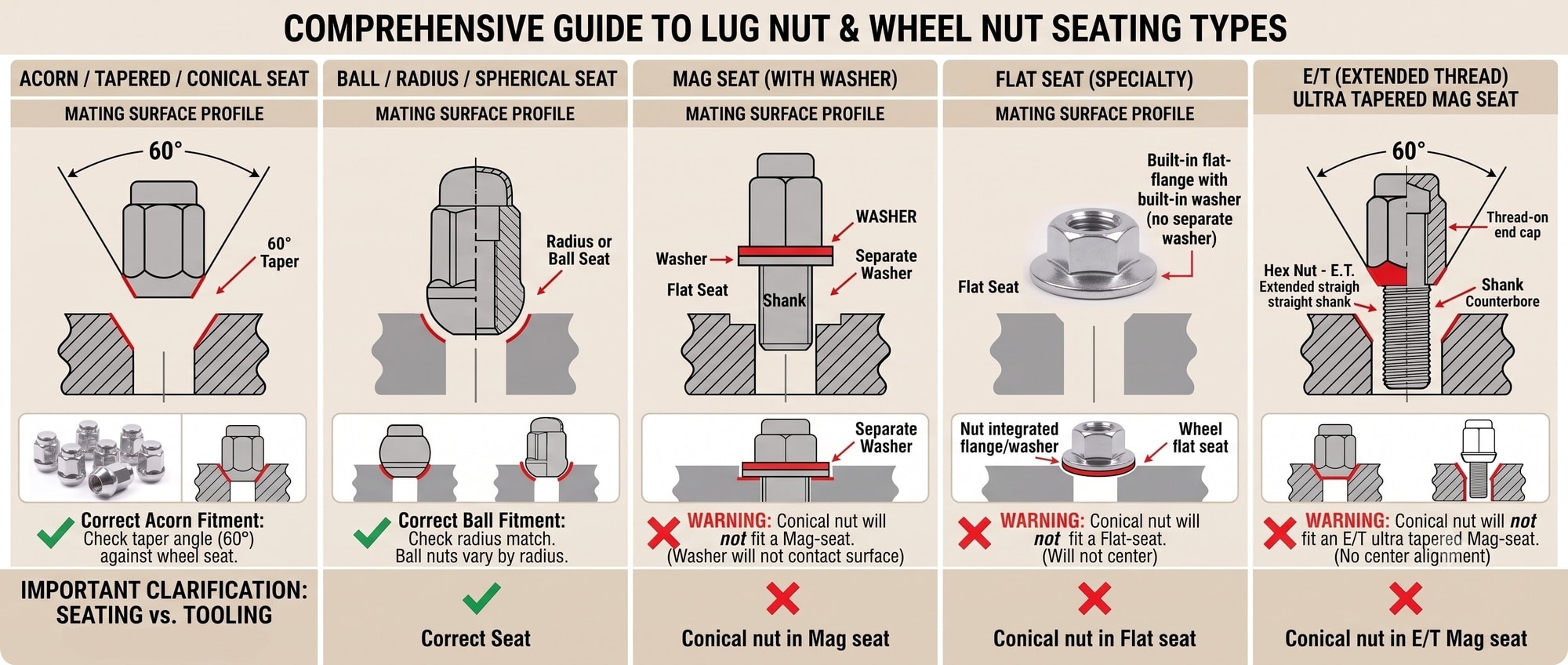
Seat angle and type must match the wheel exactly. A mismatched taper, even by a few degrees, causes poor seating, uneven clamp load, and can loosen in service, a documented problem across enthusiast communities where aftermarket nuts sold as a like-for-like fit have turned out to carry a different taper to the original.
Hard-to-Find and Obsolete Thread Forms
Modern wheel nut catalogues are dominated by a small number of common metric pitches. This creates a real problem for older vehicles, commercial and agricultural equipment, and non-UK market imports, where the original thread form has fallen out of routine stock production. We regularly manufacture wheel nuts in:
- Obsolete or non-preferred whitform or metric pitches no longer held by volume stockists
- UNF and UNC threads for older US-market and classic vehicles
- BSF and BSW threads for pre-1970s British vehicles
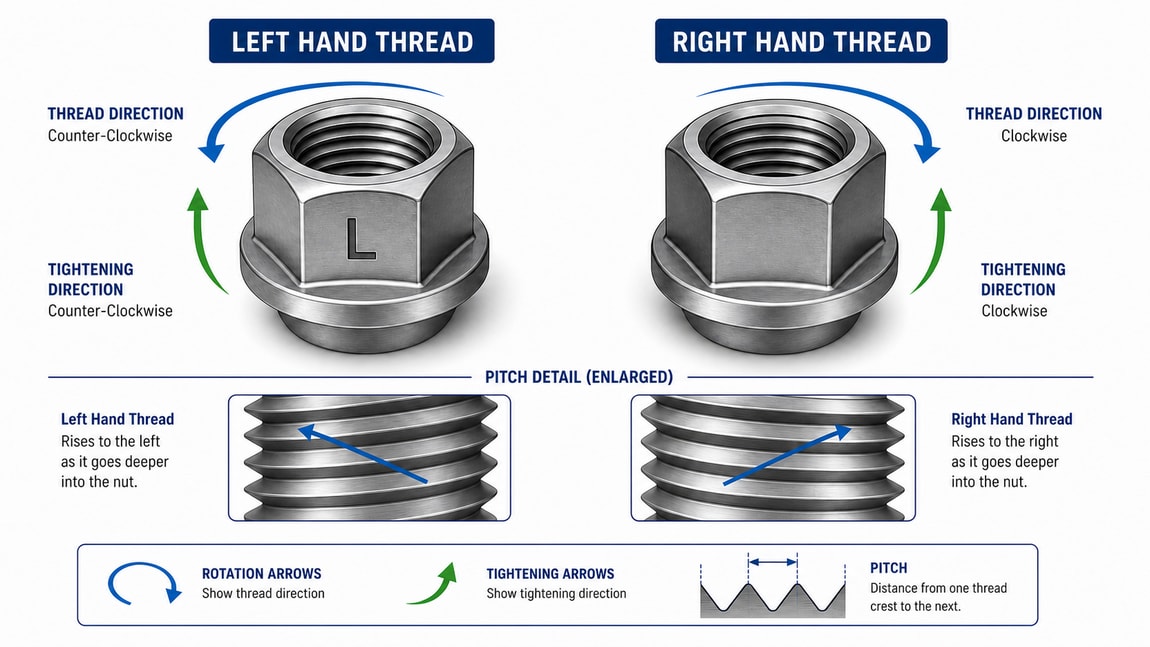
- Left-hand threads, historically fitted to one side of certain vehicles to counteract loosening from wheel rotation direction
- Custom or special pitches matched to a worn or non-standard stud
If a wheel nut cannot be sourced because the pitch, thread form, or seat geometry is no longer commercially available, that is precisely the work we take on.
Strength Grades
Wheel nuts are safety-critical. The property class must be correctly matched to the mating stud or bolt, an under-strength nut on a high-tensile stud is a genuine safety risk, not a specification nicety.
| PROPERTY CLASS | TYPICAL APPLICATION |
|---|---|
| 8 | Passenger car, standard duty |
| 10 | Passenger car and light commercial, higher clamp load requirements |
| 12 | Commercial vehicle, HGV, and high-load applications |
Always confirm nut and stud property class against the vehicle or equipment manufacturer's original specification, particularly for HGV and trailer applications.
Materials
Manufactured in medium carbon steel (EN8, EN16T) and high-tensile steel grades, with zinc plating, zinc-flake (Geomet), or black oxide finishes depending on corrosion environment and OEM finish requirements.
Restoration and Heritage Vehicle Wheel Nuts
We regularly manufacture wheel nuts for classic and vintage vehicle restoration, including Morris Minor and other Morris marque applications, where the original thread form, seat angle, or across-flats dimension is no longer available from mainstream suppliers. This typically involves reverse engineering from an original or worn sample, since drawings for these applications rarely survive intact.
A Known Grey Area: Morris Minor Wheel Nut Taper
The correct taper angle for original Morris Minor wheel nuts and bolts is not consistently documented, and enthusiast communities have repeatedly had to measure original components directly rather than rely on a published specification. Reported figures include 60° for early Series MM wheel bolts and for aftermarket alloy wheel fitments, though the Series II and 1000 steel wheel nut taper has not been definitively published anywhere we have found, and is known to differ from the visually similar 3/8" UNF Mini wheel nut taper, a mismatch that has caused fitment and safety problems for owners.
Send Us Your Original Wheel Nut, Any Condition
If you own a Morris Minor, or any classic vehicle where the correct wheel nut specification is no longer reliably documented, send us an original wheel nut or bolt from your car, regardless of wear or condition. Thread form, pitch, and across-flats size can be accurately determined even from a worn sample. Where the taper or seat angle has been worn by age or repeated tightening, we can often cross-reference against multiple samples, or against a less-worn example from elsewhere on the same vehicle, to establish the original figure with confidence. We return your original part along with our findings, and manufacture a matching replacement to the correct specification.
Custom Manufacture
Provide a drawing, sample, or the original wheel nut for reverse engineering, and we will match thread form, seat angle, across-flats size, overall length, and property class.
| STANDARD | DESCRIPTION |
|---|---|
| DIN74361A-1982 | Hexagon Spherical Nuts with Flange |
| DIN74361-2-B-1982 | Hexagon nuts with Flange Type B |
| DIN74361-2-F-1982 | Conical Nuts Type F |
| JIS D 2701-1993 | Wheel Nuts with Spherical Flange |


FREQUENTLY ASKED QUESTIONS
1. What is the difference between a wheel nut and a wheel bolt?
A wheel nut is an internally threaded fastener that fits onto a threaded stud projecting from the wheel hub. A wheel bolt is externally threaded and screws directly into a tapped hole in the hub. Trojan manufactures wheel nuts only.
2. Why are wheel nuts usually conical, and why does the angle matter?
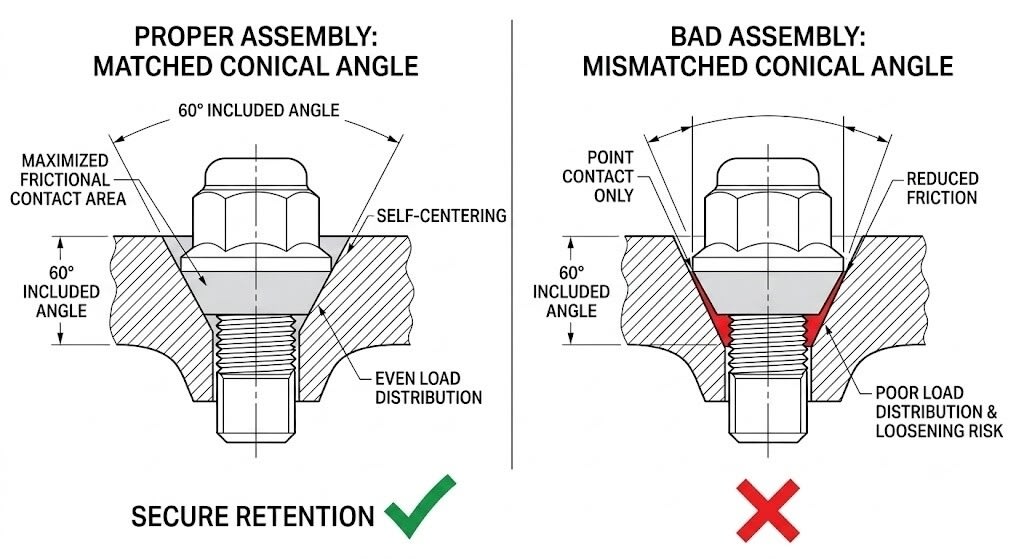
The conical seat centres the wheel on the hub as the nut is tightened, correcting small misalignments and distributing clamp load evenly. Using the wrong seat angle for a given wheel can prevent proper centring and cause loosening.
Conical wheel nuts are essential for three key reasons:
- Self-Centring:As you tighten the nut, the matching conical surfaces guide the wheel hole perfectly onto the stud, centring the wheel on the hub to correct minor misalignments.
- Even Load Distribution: The taper ensures that the immense clamping force from the tightened nut is distributed uniformly around the wheel stud hole, preventing localized stress concentrations that could damage the wheel or stud.
- Preventing Loosening: This is critical. The conical shape increases the total surface area in contact between the nut and the wheel compared to a flat seat. This larger area generates significantly more friction, which resists the natural vibration and torque that try to loosen the wheel nuts during driving.
The angle is crucial because a proper connection requires an exact match between the cone of the nut and the tapered hole in the wheel.
Proper Match: When the angles match (e.g., a standard 60-degree included angle), the surfaces mate perfectly, maximizing contact area and friction for secure retention.
Bad Match: If the angles do not match (as shown in the right-hand diagram), the contact is localized (e.g., point contact or line contact) rather than surface contact. This dramatically reduces friction and contact area, making the nut prone to loosening over time and preventing the centering and load-distribution benefits. Using mismatched nuts and wheels is dangerous and can lead to wheel failure. This is why you should always use the correct lug seat type specified for your wheels.
3. What is a radius or spherical seat wheel nut?
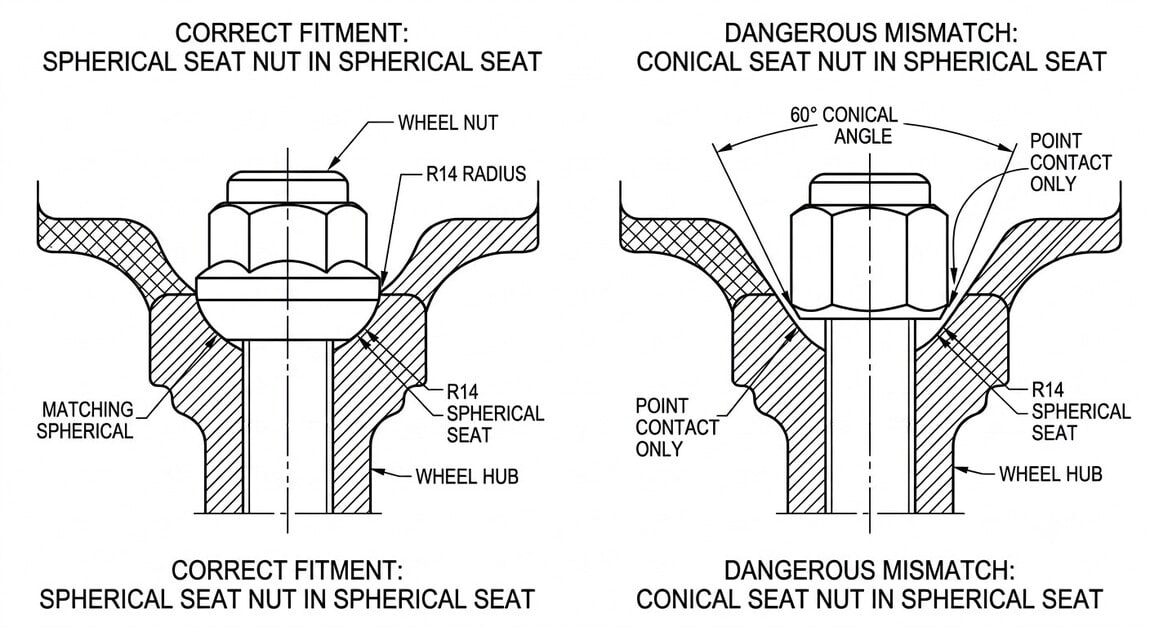
A radius or spherical seat wheel nut (commonly referred to as a ball seat nut) is a specialised fastener featuring a curved, dome-shaped bearing face rather than a flat or tapered profile.
According to standard engineering classifications - such as DIN 74361 (which governs wheel fasteners for motor vehicles) - the geometry of a wheel nut's clamping surface must explicitly match the matching profile of the wheel's mounting hole.
Mechanical Design and Function
- Load Distribution: The spherical radius is engineered to mate perfectly into a hemispherical recess. This configuration provides uniform surface-to-surface contact across the curve, distributing the massive axial clamping force evenly and preventing high-stress concentration points that could distort or fracture the wheel material around the hole.
- Aiding Alignment: As the nut is torqued onto the stud, the curved profile acts as a self-centering mechanism. It naturally coaxes the wheel hole into a perfect concentric position relative to the axis of the wheel stud, correcting minor misalignments.
- Frictional Contact Zone: The radial surface area generates substantial frictional resistance when fully torqued. This friction is essential to absorb rotational vibration, cornering forces, and thermal expansion cycles from braking, keeping the fastener from backing off or loosening under stress.
Critical Fitment Standards
Unlike aftermarket wheels which frequently rely on a 60-degree conical taper, spherical/radius configurations are highly standardised by several major European Original Equipment Manufacturers (OEMs).
The radius of the curvature is critical. For instance, automotive manufacturing standards specify specific ball profiles (such as an R12, R13, or R14 radius, denoting the radius of the sphere in millimetres) depending on the vehicle platform and stud thread diameter (e.g., M12 or M14 sizes).
Mixing a radius seat nut with a conical seat wheel creates a highly dangerous mismatch where contact is reduced to a thin line or point, severely reducing friction and leading to immediate torque loss or stress failure.
4. What is a flanged wheel nut and why would I need one?
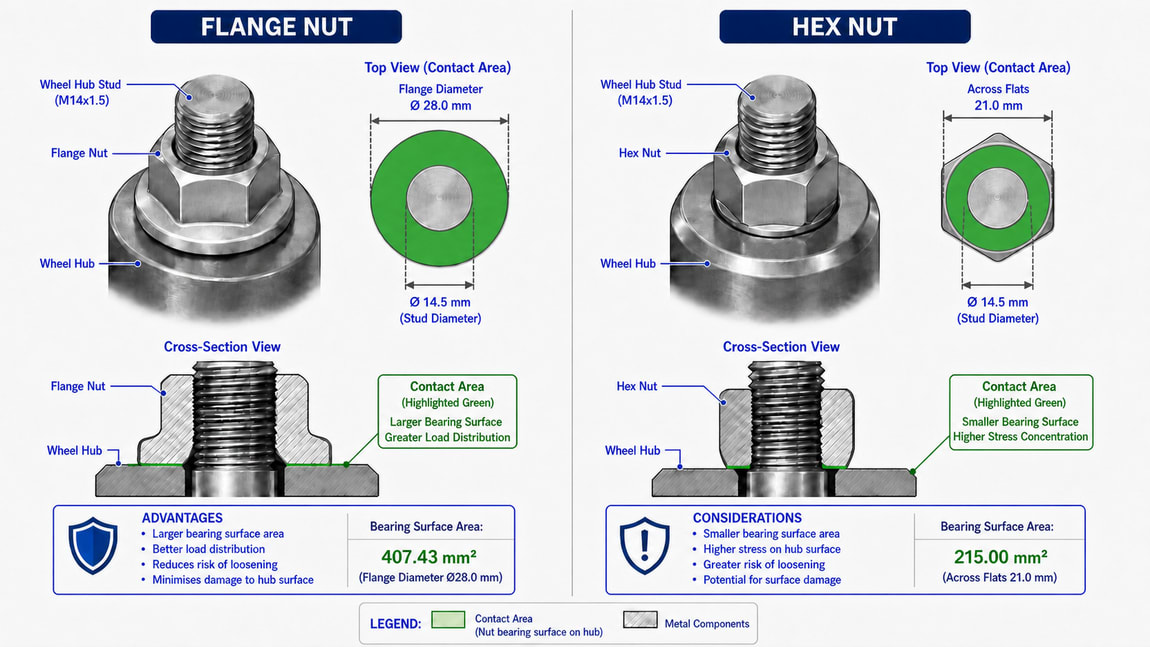
A flanged wheel nut is a specific type of wheel fastener designed to increase the surface area between the nut and the wheel. By increasing the area of the bearing surface, the clamp load is distributed across a much larger region. This is particularly critical when working with softer materials like alloy, as it helps to prevent deformation, pulling through, or galling. It is a specific type of wheel fastener designed with an integral, built-in collar (the "flange") at the base of the hex body. While standard nuts rely only on the area immediately beneath the hex flats, a flanged nut provides a much larger, flat bearing surface against the wheel.
Why are they necessary and why would you need them?
The primary reason to use flanged wheel nuts is to manage high clamping forces, especially with softer materials like aluminium or magnesium alloy wheels. Standard nuts can concentrate the load over a very small area, creating several potential failure modes:
- Preventing Alloy Pulldown and Damage: Alloy wheels are softer than steel. A standard nut under torque can "bite" into the wheel material, creating indentation or galling. A flanged nut significantly spreads this pressure over a larger surface area, reducing the risk of damaging the wheel.
- Preventing "Pull-Through": In extreme cases of over-torque or excessive load, a standard nut's minimal bearing area could potentially allow the entire hex head to be pulled through the softened alloy material. The large flange makes this physically impossible by creating a much wider footprint.
- Improved Fastener Retention: A broader bearing surface increases the frictional interface between the nut and the wheel. More friction provides better resistance against vibrational loosening, ensuring the nut stays tighter under dynamic conditions.
A flanged nut can also often incorporate a built-in locking mechanism or surface feature like serrations to provide even greater resistance to loosening.
5. Do you manufacture splined or security wheel nuts?
No. We manufacture hexagon and square profile wheel nuts only. We do not machine splined, broached, or multi-lobe locking head profiles.
6. What property class should a wheel nut be?
This depends on the vehicle or equipment manufacturer's original specification and the property class of the mating stud. We commonly manufacture to property classes 8, 10, and 12.
Understanding Wheel Nut Property Classes
Selecting the correct wheel nut goes far beyond its thread size and seat type; the mechanical strength, often defined by a "property class," is critical for safety. The user should always match the vehicle or equipment manufacturer's original specifications or, at minimum, identify the property class of the mating wheel stud to ensure a proper and safe connection.
Wheel nuts are subject to immense loads, including tension from pre-load, shear forces during acceleration and braking, and dramatic thermal cycling. Using a wheel nut with an insufficient property class can lead to stripping threads, physical deformation, and, in catastrophic cases, complete wheel detachment. This is why standard hex wheel nuts and specialised splined security nuts are both available in high-strength grades.
Identification of Markings
Most high-quality metric wheel fasteners carry property class markings. A common method is a numerical code stamped onto the nut, such as '8', '10', or '12'. These markings signify specific tensile and proof load strengths. On some nuts, a clock-face system of dots or dashes can also indicate the class. In contrast, SAE (fractional) fasteners use a line-marking system to designate grades (e.g., Grade 5, Grade 8, which are not the same as metric Property Classes 5 or 8).
Wheel Nut Property Class Comparison Table
The following table outlines the most common metric property classes for wheel nuts and provides general context on their applications and material properties, based on common manufacturing standards (such as ISO 898-2 for nuts).
| Property Class (Metric) | Symbol Marking | Material | Relative Tensile Strength | Common Applications / Notes |
|---|---|---|---|---|
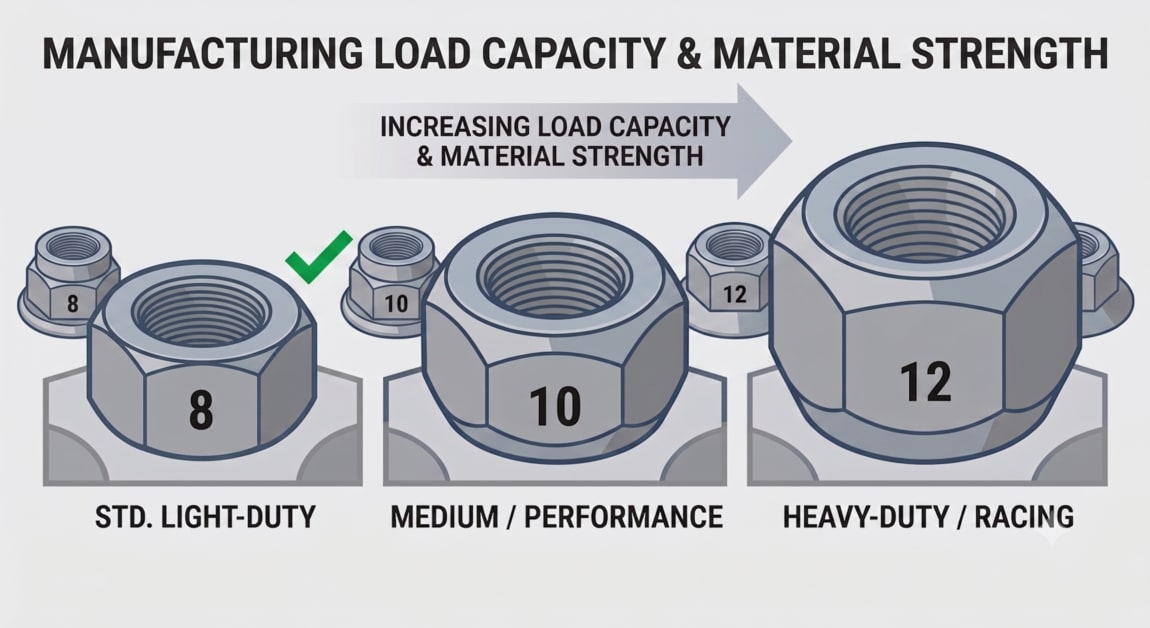
| 8 | 8 or 08 | Carbon steel, quenched and tempered. | Standard | Standard passenger vehicles, light-duty trailers. Often used with Class 8.8 studs. |
| 10 | 10 or 010 | Alloy steel, quenched and tempered. | High | Performance vehicles, commercial vehicles, and applications demanding higher clamping loads. Used with Class 10.9 studs. |
| 12 | 12 | High-alloy steel, quenched and tempered. | Very High | Heavy-duty commercial vehicles, racing, and critical heavy equipment. Requires careful installation to prevent hydrogen embrittlement. Used with Class 12.9 studs. |
This table is for general reference. Manufacturing specific values depend on diameter and standard. Always consult exact manufacturer data.
Always Match Grading to Specifications
The most critical safety practice is: Always try to match manufacturer wheel nut grading based off specifications or markings on the wheel nuts themselves.
If replacement nuts are needed, never guess the grade. Examine the existing, original nuts for markings. If markings are absent or unreadable, consult the vehicle’s workshop manual or the manufacturer’s specifications. Replacement fasteners must have a property class equal to or greater than the original equipment. A wheel assembly designed for a high-strength Class 10 nut will be compromised if a lower Class 8 nut is installed, even if it is torqued correctly. The correct torque values are specific to the property class, thread friction, and surface condition. Using an incorrect combination can lead to either under-tightening or dangerous over-stressing.
The illustration below visualises how the physical robustess of wheel nuts increases with their numerical property class designation.
7. Can you match an obsolete or hard-to-find thread pitch?
Yes. We regularly manufacture wheel nuts in obsolete metric pitches, UNF, UNC, and BSF threads for classic, commercial, and non-UK market vehicles where the original thread is no longer commercially stocked.
8. Why do some vehicles use left-hand thread wheel nuts?
Certain older vehicles used left-hand threads on one side of the vehicle to counteract the tendency of the nut to loosen under the rotational direction of the wheel.